Last updated: 27/05/2026| Researched against ph.iherb.com and Philippine Bureau of Customs
One of the most common questions Filipino consumers have before placing their first iHerb order is the customs question: will I be charged duty? Will my package be held? Do I need any special permits? The good news is that for the vast majority of personal-use iHerb orders, the answer is no – no duty, no permits, no customs holds. iHerb has structured its Philippine shipping policy specifically to keep most orders below the Philippines de minimis threshold.
But the system isn’t always intuitive. Orders near the limit may get assessed for duty due to exchange rate fluctuation. Bulk supplements over 500 grams may trigger FDA review. And the difference between customs duty, import VAT, and courier brokerage fees confuses even experienced shoppers. This guide walks through every aspect of Philippine customs as it applies to iHerb orders, with verified information from official sources.
Quick answer: Personal-use iHerb orders below approximately USD 170 (around PHP 10,000) typically clear Philippine customs without duty assessment under the de minimis rule. The exception is supplements weighing over 500 grams per container, which may require FDA permits. iHerb has set its maximum order value at USD 170 specifically to match this threshold. Read on for the full picture, including what to do if your shipment is flagged for assessment.
Quick Verdict: Will You Pay Customs Duty?
For most Filipino iHerb shoppers, customs duty is not a concern. Personal-use orders shipped via iHerb’s Global Air with Tracking service (using Ninja Van or SF Express) typically clear Philippine Bureau of Customs without duty assessment when they fall under the de minimis threshold. Here is what determines whether you will pay duty:
| Order Scenario | Likely Duty Outcome |
| Cart value under USD 150 (about PHP 8,500) | Almost never assessed for duty |
| Cart value USD 150-170 (about PHP 8,500-10,000) | Usually no duty, but exchange rate fluctuation may trigger |
| Cart value at iHerb maximum USD 170 | Sometimes assessed due to currency conversion at customs |
| Cart value over USD 170 | Cannot be ordered through iHerb (rejected at checkout) |
| Supplements with single container over 500g | May require FDA permit regardless of value |
| Multiple iHerb orders in short timeframe | May be flagged as commercial activity |
Understanding the De Minimis Rule
Philippine customs law includes a de minimis provision under Section 423 of the Customs Modernization and Tariff Act (CMTA), which exempts low-value imports from customs duty assessment. This rule is what allows the vast majority of iHerb orders to clear customs without additional charges.
The de minimis threshold
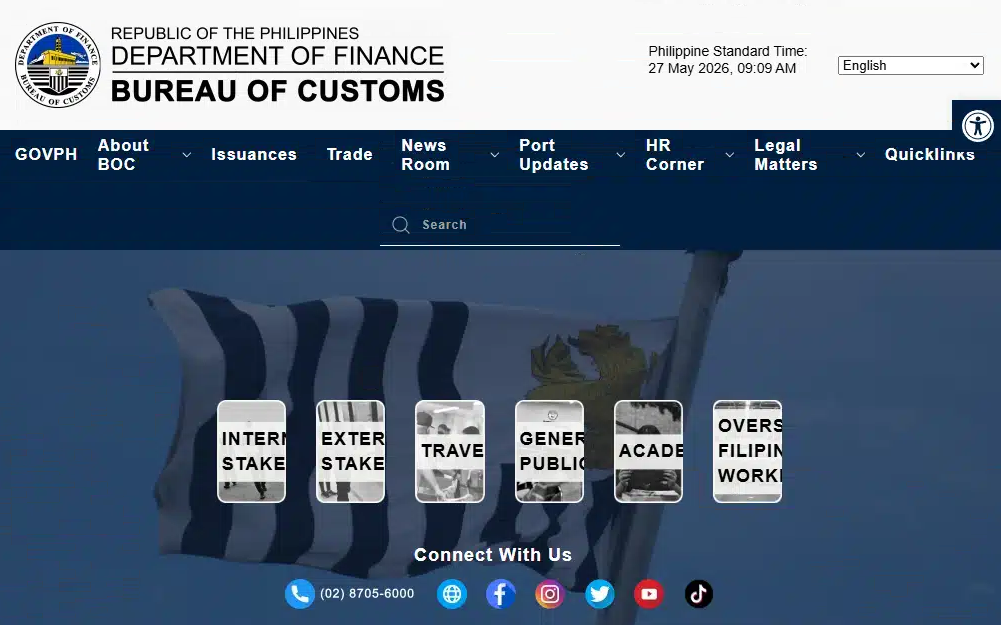
Under current Philippine Bureau of Customs rules, the de minimis threshold for personal-use imports is approximately PHP 10,000 in dutiable value. Shipments below this threshold are generally exempt from customs duty under simplified clearance procedures. The exact threshold can be adjusted by the Bureau of Customs from time to time, so consult customs.gov.ph for the current figure if your order is near the limit.
What counts as dutiable value
Dutiable value is calculated based on the product cost in Philippine peso terms at the time customs processes the shipment. This typically excludes shipping costs but uses the exchange rate at the moment of assessment, which can differ from the rate displayed at iHerb checkout. This is why orders right at the USD 170 threshold sometimes get flagged when the peso depreciates between order and customs clearance.
Personal use vs commercial import
The de minimis exemption applies specifically to personal-use imports. Personal use is generally interpreted as quantities reasonable for individual consumption, not commercial resale. Customs officers have discretion to evaluate whether a shipment looks personal or commercial – factors like multiple units of the same product, frequent repeated shipments to the same address, or business delivery addresses can shift a shipment from personal to commercial classification.
Why iHerb Caps Orders at USD 170
iHerb’s official maximum order value for Philippine delivery is USD 170. This is not arbitrary – it is set deliberately just under the Philippines de minimis threshold to keep customers within the duty-free zone for almost every order.
If you exceed USD 170 in cart value, iHerb’s checkout will not accept the order for Philippine delivery. You will be required to remove items, split into multiple orders, or change delivery country. This is iHerb’s way of protecting customers from accidentally triggering customs duty assessment.
Why iHerb does not cap at exactly USD 175 (the actual Philippine threshold in peso terms)? Because exchange rate fluctuation can push a USD 175 order over PHP 10,000 by the time customs processes it. iHerb’s USD 170 cap builds in roughly 3 percent buffer for exchange rate movement, protecting the vast majority of orders.
What Could Trigger a Duty Assessment
Even with iHerb’s order cap, some shipments do get assessed for duty at customs. Understanding the triggers helps you avoid them:
Trigger 1: Currency exchange rate fluctuation
iHerb’s official Philippine shipping page explicitly warns: ‘Orders near the tax-free limit may be assessed by Duties and Taxes (D&T) as the currency exchange rate may vary.’ If you place an order at USD 165-170 and the peso depreciates 5-10 percent before customs processes the shipment, the PHP-equivalent value may exceed PHP 10,000 even though the USD value did not change.
Trigger 2: Multiple shipments in short timeframe
Customs officers look at patterns. If you place three iHerb orders within a week, totaling well over PHP 30,000 in combined value, customs may treat the cumulative pattern as commercial activity even though each individual order is under the threshold. Spacing your orders by at least one week reduces this risk.
Trigger 3: Same product in large quantity
Ordering 10 of the same protein powder or 20 of the same multivitamin signals to customs that the shipment may be for resale rather than personal use. Varying your product mix across orders helps maintain the personal-use classification.
Trigger 4: Business or commercial delivery address
Shipping iHerb orders to office addresses, business names, or commercial buildings can flag the shipment as B2B (business-to-business) rather than B2C (business-to-consumer). Use a residential address for personal orders.
Trigger 5: Suspicious documentation patterns
Customs may flag shipments where the declared value seems too low for the product mix, where previous shipments to the same address have shown discrepancies, or where the recipient has been previously cited for customs violations.
How Duty Is Calculated When Charged
If your shipment is assessed for duty, the calculation typically involves several components. iHerb’s official policy does not specify a fixed duty rate because Philippine customs uses tariff classifications that vary by product category. However, common ranges for personal-use supplement and skincare imports above the de minimis threshold include:
Common duty components
- Customs duty: typically 5-15 percent for supplements and personal care, depending on tariff classification
- Import VAT (Value Added Tax): 12 percent on (CIF value + customs duty), where CIF is the cost-insurance-freight base
- Brokerage fee: charged by the courier (Ninja Van or SF Express) for handling customs clearance, typically PHP 200-1,000
- Documentary stamp tax and similar minor fees: usually under PHP 100
Example calculation
Hypothetical: order valued at PHP 12,000 (over the threshold) consisting of supplements:
| Component | Calculation | Amount (PHP) |
| Order value (CIF basis) | Cart total | 12,000 |
| Customs duty | 10 percent of CIF | 1,200 |
| Import VAT | 12 percent of (CIF + duty) | 1,584 |
| Brokerage fee | Courier handling fee | 500 |
| TOTAL additional charges | duty + VAT + brokerage | approximately 3,284 |
This is illustrative only. Actual rates depend on Bureau of Customs classification of your specific products. Refer to customs.gov.ph or consult a customs broker for precise calculations.
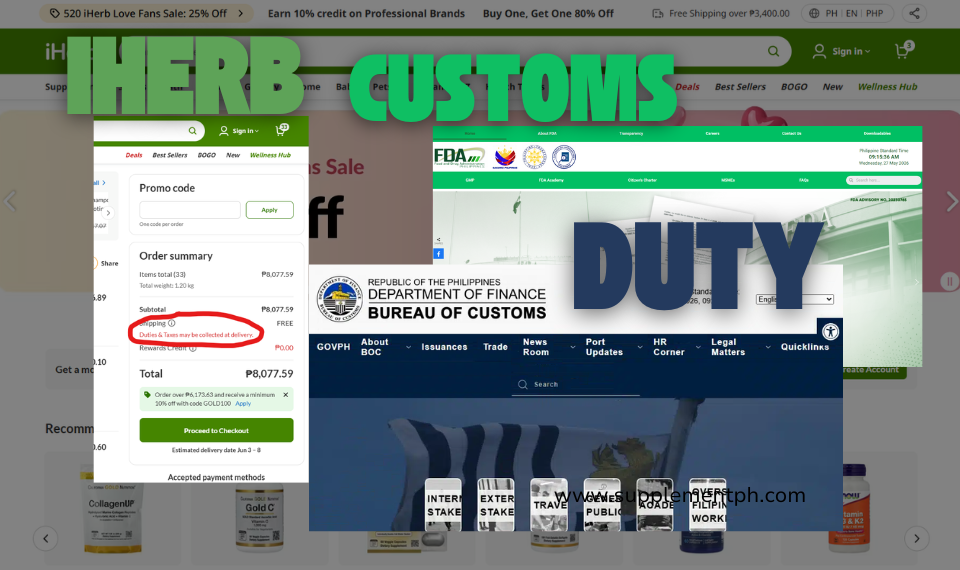
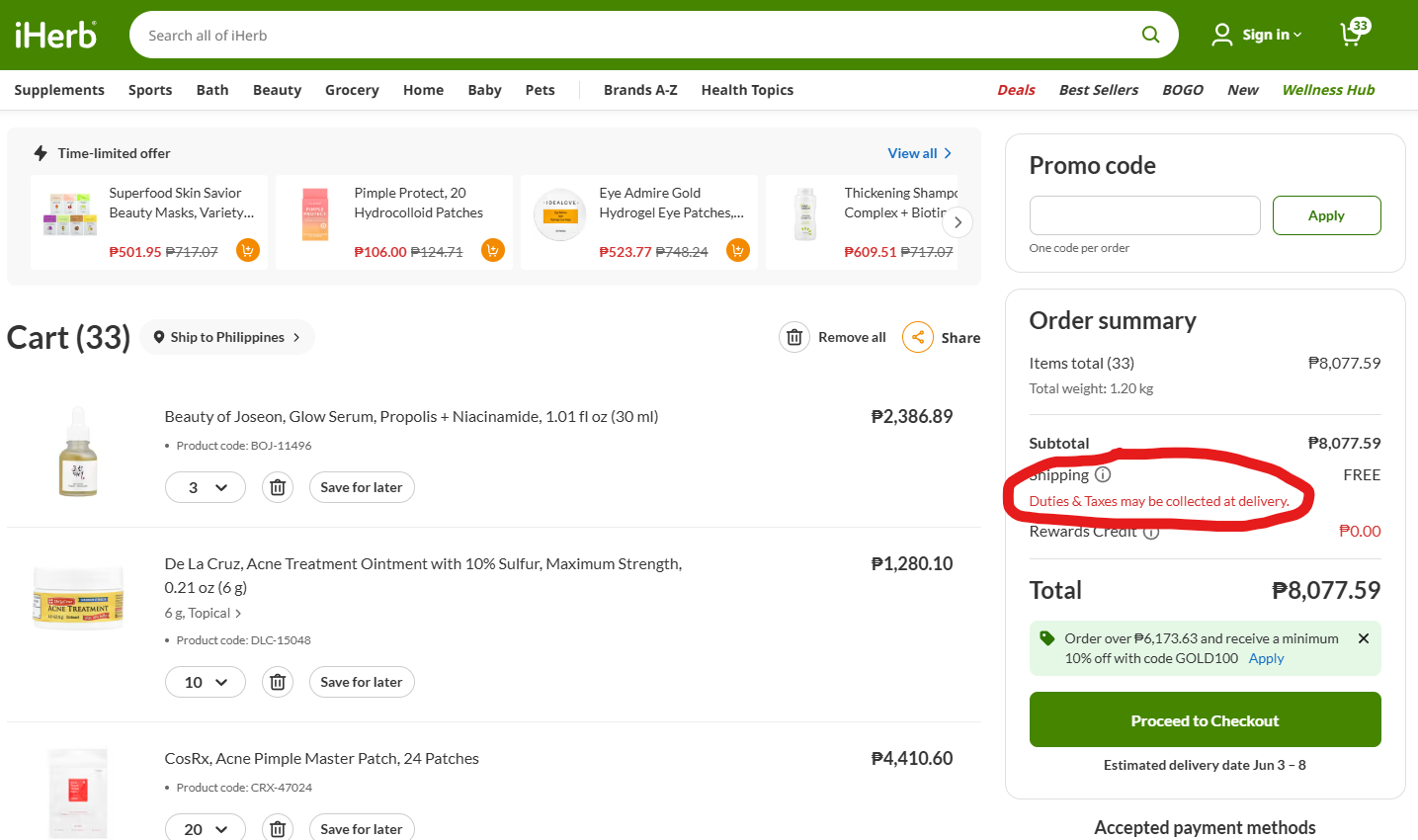
Important: customs charges are billed directly by the carrier (Ninja Van or SF Express), not by iHerb. You pay the carrier before they release your package for final delivery. iHerb does not estimate or collect customs duties at checkout.
The FDA 500-Gram Rule for Supplements
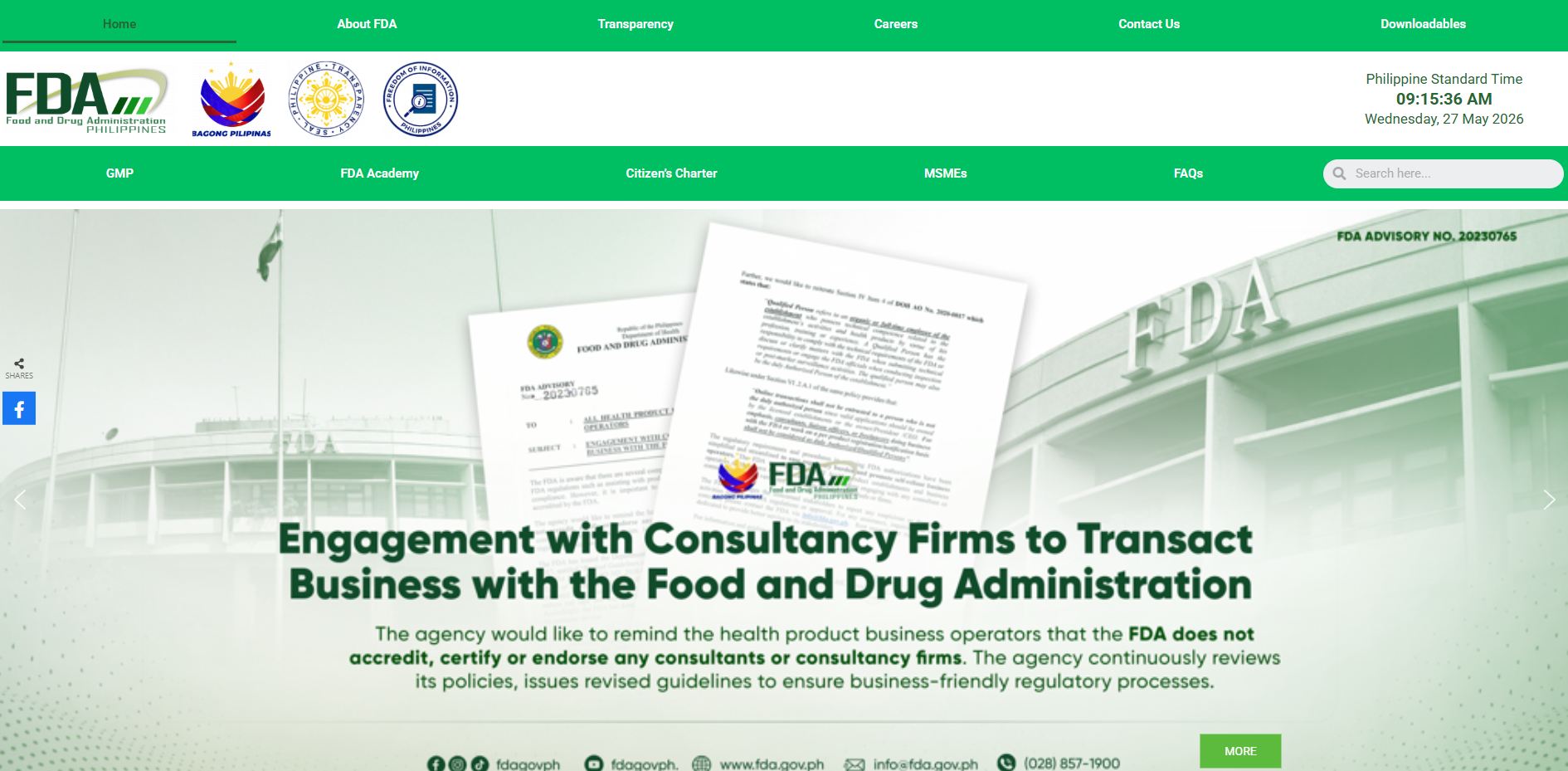
Separate from customs duty assessment, Philippine FDA has regulations governing personal imports of dietary supplements. iHerb’s official shipping policy states: ‘Orders with supplements over 500 g may require FDA permits for import.’
What the 500g rule means in practice
The 500-gram threshold applies to individual container weight, not total cart weight. A single container exceeding 500 grams may trigger FDA review for personal import permit. The rule exists to prevent unregulated bulk supplement imports for resale.
Which products commonly exceed 500 grams
- Protein powder tubs (most are 1 kg or 2.27 kg sizes)
- Collagen powder containers (often 500g to 1 kg)
- Meal replacement and superfood powders
- Large amino acid or creatine powders (1 kg)
- Bulk fiber or psyllium supplements
- Large beauty drinks or liquid supplements
Products that almost never trigger the rule
- Capsule and tablet supplements (typically 200-300g per bottle including packaging)
- K-beauty skincare products (usually under 200g)
- Sheet masks (lightweight)
- Small powder packets or single-serving products
How enforcement actually works
The 500-gram rule is enforced inconsistently in practice. Many Filipino consumers report receiving 1 kg protein powder containers without FDA permit issues. However, you should not rely on lenient enforcement – if customs decides to enforce strictly, your shipment may be held pending FDA permit submission, which can take weeks. The safer path is to order smaller container sizes when available.
Duty vs VAT vs Brokerage Fee Explained
These three terms often get confused. Understanding the differences helps when you receive a customs bill from the carrier:
Customs duty
Customs duty is a tax imposed on imported goods by the Philippine government. It is calculated based on the Bureau of Customs tariff schedule, which categorizes products by Harmonized System (HS) code. Different categories have different duty rates. For supplements and personal care products imported for personal use above the de minimis threshold, duty typically ranges from 5 percent to 15 percent of the dutiable value.
Import VAT (Value Added Tax)
Import VAT is a separate tax applied to most imported goods at 12 percent. It is calculated on the CIF value (Cost + Insurance + Freight) plus any customs duty already imposed. So if your shipment has duty applied, VAT is calculated on the post-duty value, making it slightly higher than VAT on pre-duty value alone.
Brokerage fee (handling fee)
The brokerage fee is charged by the courier (Ninja Van or SF Express), not the government. It compensates the carrier for handling customs paperwork, processing fees, and coordination with the Bureau of Customs. For Philippine iHerb shipments via Global Air with Tracking, brokerage fees typically range from PHP 200 to PHP 1,000 depending on shipment complexity.
Documentary stamp tax
A small tax on official documents related to import processing. Usually under PHP 100 and rolled into the carrier’s final bill.
When the carrier contacts you about customs charges, they will provide an itemized breakdown of duty + VAT + brokerage fee. The total is what you pay before package release. Save the receipt – it serves as proof of customs payment if questions arise later.
How to Pay Customs Charges When Assessed
If your shipment is assessed for customs charges, here is the typical process:
- Your shipment arrives at Philippine customs and gets flagged for assessment
- Customs calculates duty + VAT + applicable fees
- The carrier (Ninja Van or SF Express) contacts you via SMS or email with payment instructions
- You receive an itemized invoice showing: customs duty, import VAT, brokerage fee, total amount
- Pay through the carrier’s payment portal (online banking, GCash, credit card, or cash on collection)
- Carrier confirms payment and releases your package for final delivery
- Package delivered to your address typically within 1-3 days of payment
Payment methods accepted by carriers
- Ninja Van: GCash, online banking, credit cards, cash on delivery (varies by area)
- SF Express: Online portal, bank transfer, credit card
What if you refuse to pay?
If you decline to pay customs charges, the carrier typically returns the package to iHerb after 30-60 days of unclaimed status. iHerb may then issue a refund (minus original shipping fee). This is the option of last resort – it loses you the original shipping cost and the time invested in the order.
Strategies to Stay Under the Threshold
Strategy 1: Target USD 150 maximum, not USD 170
Building in a 10-20 USD buffer below iHerb’s order cap protects against currency exchange rate fluctuation. A USD 150 order will almost never trigger duty even if the peso depreciates significantly between order placement and customs processing.
Strategy 2: Split larger purchases into multiple orders
If you need PHP 20,000 worth of supplements, place two orders at PHP 9,000-10,000 each, spaced 1-2 weeks apart. Each individual shipment stays under the threshold, and the spacing reduces the risk of customs treating them as one commercial pattern.
Strategy 3: Choose smaller container sizes
For protein powders, collagen powders, and other potentially FDA-flagged supplements, choose smaller container sizes (under 500g per container) when available. Multiple smaller containers may cost slightly more per gram than one large container, but they avoid both the FDA permit issue and may pack better against the USD 170 cap.
Strategy 4: Diversify product mix
Instead of ordering 5 bottles of the same multivitamin, order one each of multivitamin, vitamin C, vitamin D, omega-3, and collagen. The varied mix reads as personal use rather than commercial stockpiling.
Strategy 5: Use residential delivery address
Avoid shipping to office addresses, business buildings, or commercial recipients. Use your home address and your individual name (not company name) on the shipping label.
Strategy 6: Time orders during stable peso periods
If you have flexibility, watch the USD/PHP exchange rate before placing large orders. Orders placed during periods of peso stability or appreciation face lower risk of duty trigger from currency fluctuation.
What to Do If Your Shipment Is Held
Step 1: Check tracking status carefully
If tracking shows your package stuck at customs for more than 5-7 business days, it may be held for assessment, FDA review, or documentation verification. Sometimes the hold resolves automatically; sometimes it requires action from you.
Step 2: Contact the carrier
Reach out to Ninja Van Philippines or SF Express (whichever is shipping your order) through their support channel. SF Express Philippines phone is 09985881865 per iHerb’s official shipping page. They can confirm the hold reason and next steps.
Step 3: Provide requested documentation if needed
If FDA permit is required, you will need to either apply for a personal use permit (via fda.gov.ph) or work with the carrier to determine if a permit waiver applies. This process can take 2-4 weeks. If you do not have the time, the carrier will return the shipment to iHerb.
Step 4: Pay customs charges if assessed
If the hold is for duty assessment rather than documentation, simply pay the assessed amount via the carrier’s payment portal. Package releases within 1-2 days of payment confirmation.
Step 5: Contact iHerb for refund if shipment is returned
If you decide not to pay charges or cannot provide required documents, the carrier will eventually return the shipment to iHerb. Contact iHerb support via ph.iherb.com help center to initiate refund. Refund typically covers product cost minus original shipping fee.
Common Misconceptions About iHerb Customs
Misconception 1: All iHerb orders get charged customs duty
False. The vast majority of iHerb orders under USD 150 clear Philippine customs without any duty assessment. The de minimis rule exempts these shipments by default. Only orders near or above the PHP 10,000 threshold face significant duty risk.
Misconception 2: Duty is a fixed 12 percent of cart value
Partially false. The 12 percent figure refers to import VAT, which is one component of total customs charges. Actual customs duty varies by product category (typically 5-15 percent) and is calculated separately from VAT. Total customs charges typically include duty + VAT + brokerage fee, not just a single 12 percent.
Misconception 3: iHerb collects customs duty at checkout
False. iHerb does not collect customs duty. If your shipment is assessed for duty, the carrier (Ninja Van or SF Express) bills you directly before releasing the package. iHerb’s checkout total only includes product cost and shipping (when applicable).
Misconception 4: FDA permit is required for all supplements
False. The FDA permit requirement applies specifically to individual supplement containers over 500 grams. Standard capsule and tablet supplements (200-300g per bottle) do not require permits regardless of cart total.
Misconception 5: You can avoid customs by understating value
False and risky. iHerb declares actual product value to customs – you cannot influence this. Attempting to understate value through third-party shipping services or customs declarations is potentially illegal and can result in shipment seizure, fines, or future shipping restrictions.
Misconception 6: Multiple small orders are always cheaper than one large order
Not always. Each separate shipment carries its own shipping fee (or counts against the free shipping threshold separately). If you can fit your shopping under one order at PHP 9,000-10,000, that is usually more cost-efficient than two PHP 5,000 orders requiring two shipping fees.
Frequently Asked Questions
Will I definitely pay customs duty if my order exceeds USD 170?
iHerb does not allow orders over USD 170 to Philippine addresses, so this scenario does not occur through normal iHerb checkout. The cap exists precisely to prevent customers from triggering duty assessment. If you somehow exceeded the limit through workaround, yes, duty assessment becomes very likely.
Does the de minimis threshold change?
The Philippine Bureau of Customs has the authority to adjust the de minimis threshold periodically. It has been at PHP 10,000 for several years. Always check customs.gov.ph for the current figure if your order is near the threshold.
Can customs hold my package indefinitely?
No. Packages held for documentation typically have a 30-60 day window before customs returns them to the shipper (iHerb). Packages held for duty payment release upon payment, usually within 1-3 days.
If my package gets returned to iHerb, do I get a full refund?
iHerb typically refunds the product cost when packages are returned by customs. Original shipping fee is usually not refunded. Contact iHerb customer service via ph.iherb.com help center for the specific refund process.
Does paying via GCash through iHerb affect customs?
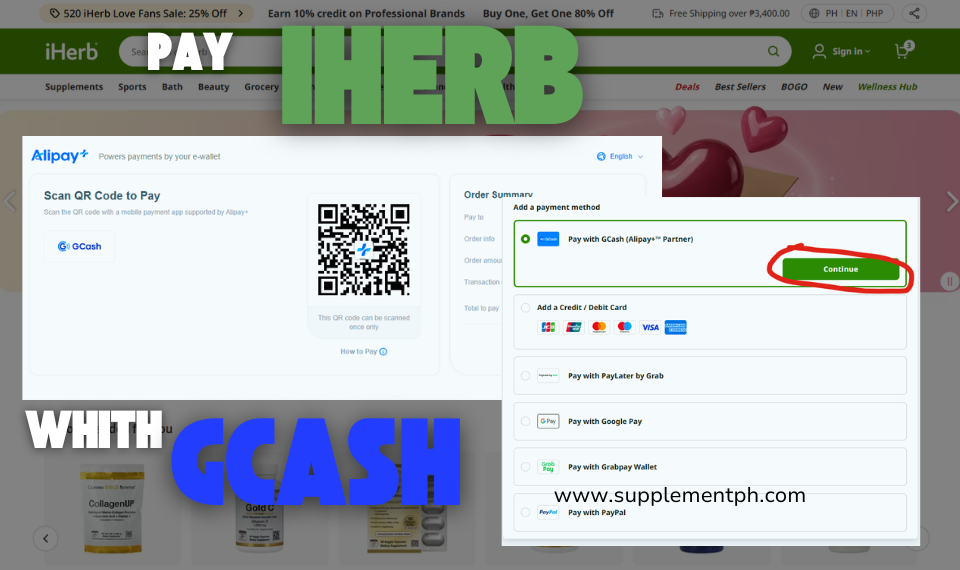
No. iHerb payment method (GCash via Alipay+, credit card, PayPal, etc.) does not affect customs treatment. Customs cares about declared product value, weight, and product type, not how you paid iHerb.
Are there any iHerb products that always require FDA permits?
iHerb’s official policy mentions supplements over 500g per container ‘may’ require permits. There is no published list of products that always require permits. Practical enforcement is inconsistent. When in doubt, choose smaller container sizes.
Can I import iHerb products commercially for resale?
iHerb’s affiliate and terms documents do not prohibit resale, but Philippine customs treats commercial imports very differently from personal use. Resellers must register as importers, pay full customs duty on every shipment, and comply with FDA business permit requirements. The hassle and cost almost always make personal-use ordering preferable.
What happens if customs charges exceed the value of my products?
Theoretically possible for very small high-tariff items, but practically rare with iHerb’s product mix. If charges seem disproportionate, you can refuse the package and request return to iHerb for refund. The total loss would be your original shipping fee plus refusal of the items.
Does Black Friday or 11.11 shipping affect customs?
Customs procedures do not change during sale events, but processing times can extend significantly due to volume. Packages arriving in late November or early December may sit at customs longer than usual. Plan for 2-3 extra days during peak shopping seasons.
If I order skincare and supplements together, are they assessed differently?
Customs applies the de minimis rule based on total shipment value, not individual product type. Mixed orders are assessed as one shipment. However, the FDA 500g rule applies to individual supplement containers only, not skincare.
Conclusion: Smart Customs Strategy for Filipinos
Philippine customs sounds intimidating but is actually quite forgiving for personal-use iHerb orders. iHerb’s USD 170 order cap is specifically calibrated to keep customers safely below the PHP 10,000 de minimis threshold. As long as you stay under the limit, vary your product mix, ship to a residential address, and avoid bulk supplement containers over 500 grams, the customs process is essentially invisible to you.
If you are placing a large order (over PHP 8,000 in cart value), target USD 150 maximum to build in a 20 USD buffer against exchange rate movement. If you need more product than that fits in one order, split into two orders spaced 1-2 weeks apart. These two strategies handle 95 percent of real-world customs scenarios.
Ready to place your iHerb order with customs confidence? Use code [YOUR-AFFILIATE-CODE] at iHerb checkout for your welcome discount. Our complete shipping guide covers delivery options and timelines. Our payment guide explains how to use GCash for international transactions. And our best products guide helps you build a cart that maximizes value under the customs threshold.
–
Related Reading on supplementph.com
- iHerb Philippines Shipping Guide 2026 (/iherb-philippines-shipping/)
- How to Pay iHerb with GCash (/iherb-gcash-payment/)
- iHerb FDA Permit Guide for Philippines (/iherb-fda-philippines-supplements/)
- Best iHerb Products for Filipinos 2026 (/best-iherb-products/)
- Is iHerb Legit? Honest Filipino Review (/is-iherb-legit/)
- iHerb Promo Codes Philippines (/iherb-promo-code/)
Sources
iHerb shipping policy verified against ph.iherb.com/shipping/ph (accessed May 2026). Philippine Bureau of Customs de minimis rule from Section 423 of the Customs Modernization and Tariff Act (CMTA), Republic Act No. 10863. Philippine FDA personal import guidelines from fda.gov.ph. Tariff and VAT calculation methodology from the Bureau of Customs official publications.
Disclaimer About Customs Information
Philippine customs rules and rates can change. The information in this guide is researched against current official sources as of the publication date but should not be treated as legal advice. For specific questions about your shipment or commercial import situations, consult a licensed customs broker or contact the Bureau of Customs directly.
Affiliate DisclosureThis article contains affiliate links to iHerb. When you make a purchase through these links, supplementph.com may earn a small commission at no additional cost to you. Our customs guidance is based on official Philippine government and iHerb source documents, not commission rates.