Before placing your first iHerb order, you probably searched ‘is iHerb FDA approved‘ to confirm the products are safe and legal to buy. This is a smart instinct – you’re being a careful consumer about what you put in your body. But the answer involves more nuance than a simple yes or no, and the most important takeaway might surprise you.
Quick answer: No, iHerb is not ‘FDA approved’ – but neither is any other supplement retailer in the world. The US FDA does NOT approve dietary supplements before they go on sale, regardless of who sells them. This is true for iHerb, Watsons, Mercury Drug, Healthy Options, and every supplement section in every store. What matters instead is iHerb’s five-pillar Quality Promise program: authentic direct sourcing, brand Certificates of Analysis, the iTested independent third-party testing program (ISO-certified labs), GMP/ISO/NSF-certified climate-controlled warehousing, and a 60-day returns guarantee. iHerb documents all of this publicly at ph.iherb.com/info/quality. Read on for the full picture.
This article explains exactly how dietary supplement regulation works in the United States and the Philippines, what ‘FDA approved‘ actually means (and doesn’t mean), how iHerb ensures product quality without traditional FDA approval, what certifications you SHOULD look for when buying supplements, and the red flags that genuinely indicate unsafe products.
By the end, you’ll have a clear framework for evaluating supplement safety that goes beyond the misleading ‘FDA approved’ label – and you’ll know whether iHerb meets the real standards that matter.
What ‘FDA Approved’ Actually Means (And Why It Doesn’t Apply to Supplements)
The phrase ‘FDA approved’ is one of the most misunderstood terms in consumer health. To understand iHerb’s regulatory status, we need to first clarify what FDA approval actually involves and which products it applies to.
FDA approval applies to drugs, not supplements
The United States Food and Drug Administration (FDA) approves prescription and over-the-counter drugs after a rigorous review process that typically takes 10-15 years and costs hundreds of millions of dollars. This process involves:
- Pre-clinical laboratory and animal testing
- Phase 1 clinical trials in small groups of healthy volunteers
- Phase 2 trials in patients with the target condition
- Phase 3 large-scale trials measuring efficacy and side effects
- FDA review of all data before granting marketing authorization
- Ongoing post-market surveillance after approval
When a drug like Lipitor, Viagra, or Tylenol is ‘FDA approved,’ it has passed through this entire process. The FDA has reviewed the science, confirmed the drug works for its stated purpose, and judged the benefits outweigh the risks.
Supplements are regulated under DSHEA, not approved
Dietary supplements – vitamins, minerals, herbs, amino acids, and similar products – are regulated under a completely different legal framework: the Dietary Supplement Health and Education Act of 1994 (DSHEA). Under DSHEA:
- Supplement manufacturers do NOT need FDA approval to sell their products
- FDA does NOT review supplement safety or efficacy before products go on sale
- FDA does NOT pre-approve supplement labels or marketing claims
- Manufacturers are responsible for ensuring their own product safety
- FDA can only take action AFTER a product is on the market if problems arise
This means no supplement – whether sold by iHerb, Watsons, Mercury Drug, GNC, Costco, or any other retailer worldwide – is ‘FDA approved’ in the way drugs are. The phrase ‘FDA approved supplement’ is technically impossible under current US law. Any product claiming this is misleading you.
Common misconception: When consumers see ‘FDA approved’ on a supplement bottle, they often assume the FDA reviewed the product the same way they review medications. They didn’t. The manufacturer may have followed FDA-required Good Manufacturing Practices (cGMP), but the product itself was never reviewed for efficacy by FDA scientists.
How iHerb is Actually Regulated by the US FDA
Despite supplements not requiring FDA approval, iHerb does operate under significant FDA oversight as a retailer headquartered in California. Here’s what the FDA actually requires from iHerb and the manufacturers they source from:
Good Manufacturing Practices (cGMP)
Every supplement manufacturer selling in the US (including those whose products appear on iHerb) must follow Current Good Manufacturing Practices (cGMP) under 21 CFR Part 111. These regulations cover:
- Facility cleanliness and contamination prevention
- Quality control at every production step
- Ingredient identity verification before manufacturing
- Finished product testing for purity and potency
- Record keeping and traceability for all batches
- Personnel training and qualification
FDA inspectors conduct unannounced inspections of supplement manufacturing facilities. Violations can result in warning letters, product recalls, import alerts, or facility shutdowns. iHerb specifically requires their suppliers to be cGMP-compliant – it’s a baseline expectation, not a premium feature.
Adverse Event Reporting
Under the Dietary Supplement and Nonprescription Drug Consumer Protection Act of 2006, supplement companies must report serious adverse events to the FDA. This includes any consumer-reported reaction resulting in hospitalization, persistent disability, or death. This creates ongoing monitoring even without pre-approval – if a supplement causes problems, the FDA learns about it through this mandatory reporting system.
Labeling Requirements
FDA enforces strict labeling standards for supplements:
- Required ‘Supplement Facts’ panel with serving size, ingredients, and amounts
- Mandatory disclaimer: ‘These statements have not been evaluated by the FDA’
- Cannot claim to cure, treat, or prevent specific diseases
- Cannot make unsubstantiated health claims
- Must list any allergens (milk, soy, wheat, etc.)
- Must include manufacturer contact information
Every supplement sold on iHerb must comply with these labeling rules. When you see the ‘These statements have not been evaluated by the FDA’ disclaimer on a bottle – this is FDA compliance in action, not a warning of danger.
Import and Customs Oversight
Many products on iHerb are manufactured in countries outside the US (Korea, Japan, Germany, Australia, etc.). For those products to be sold to US-based customers via iHerb, they must pass FDA import requirements. International manufacturers shipping to iHerb’s California warehouses must demonstrate equivalent quality standards or face FDA refusal at the border.
Philippine FDA Regulation of iHerb Imports
For Filipino buyers, the more relevant regulatory question is often: does Philippine FDA (FDA Philippines) regulate iHerb purchases? The answer involves understanding how Philippine import laws apply to international online retailers.
FDA Philippines and Republic Act 9711
The Food and Drug Administration of the Philippines was reorganized under Republic Act 9711 (the FDA Act of 2009). FDA Philippines regulates:
- Products manufactured in the Philippines for local sale
- Imported products distributed commercially within the Philippines
- Products requiring Certificate of Product Registration (CPR) for local retail
- Drugs, food, cosmetics, and medical devices sold through Philippine retail channels
What this means for iHerb shipments to Philippines
iHerb operates as an international online retailer shipping directly to Filipino consumers. This puts iHerb purchases in a specific regulatory category:
- iHerb does NOT need FDA Philippines registration because they’re not a Philippine commercial distributor
- Individual orders fall under personal use importation rules
- Philippines de minimis customs threshold (USD 170 / approximately PHP 10,000) typically exempts personal orders from formal import procedures
- BOC (Bureau of Customs) handles importation enforcement, not FDA Philippines
- Personal use is typically interpreted as quantities for one person’s consumption (3-6 month supply)
The FDA 500g rule for supplement imports
There is a commonly cited ‘500g rule’ for supplement imports into the Philippines that creates confusion. Here’s the practical reality:
- Customs may scrutinize supplement shipments exceeding 500g (cumulative supplement weight)
- Single-bottle orders rarely trigger this
- Multi-bottle bulk orders may face additional documentation requests
- In practice, customs enforcement varies and most personal orders pass through without issue
- See our separate Customs and Duty Guide for complete details
Practical bottom line: Filipino buyers purchasing iHerb for personal use generally don’t need to worry about Philippine FDA registration of products. The personal use exemption and de minimis customs threshold cover most orders. Reselling iHerb products commercially in the Philippines without proper FDA registration is illegal – but ordering for yourself is fine.
iHerb’s Official Quality Promise Programs
Beyond what US FDA regulation requires, iHerb has built a proprietary multi-layer quality assurance system documented publicly on their Quality Promise page (ph.iherb.com/info/quality). These programs go beyond the regulatory baseline and represent iHerb’s actual quality differentiator vs other supplement retailers. There are five named programs you should understand before evaluating any iHerb purchase.
Program 1: Authentic Products (Direct Sourcing)
iHerb’s first quality pillar is authenticity through direct sourcing. They state: “We work directly with brands and authorized partners to bring genuine products to our customers – with no third-party sellers.” This eliminates the counterfeit risk that plagues Shopee, Lazada, and Amazon Marketplace, where individual sellers can list potentially fake products.
- Direct relationships with manufacturers and authorized distributors only
- No third-party marketplace model – iHerb is the seller, not a platform
- Product integrity and traceability from brand to customer
- Lot numbers and batch documentation for every shipment
Program 2: Tested Ingredients (Certificates of Analysis)
For all supplements and sports nutrition products on iHerb, brands are required to provide Certificates of Analysis (COAs) – laboratory documents proving what’s in the bottle matches what’s on the label. COAs typically test for:
- Ingredient identity – confirming the active compound is actually present
- Label alignment – amount in the bottle matches the stated label dose
- Contaminants – allergens, heavy metals (lead, mercury, arsenic, cadmium)
- Microbial safety – bacteria, mold, yeast within acceptable limits
- Potency verification – active ingredient strength meets specification
These COAs are brand-provided documentation – iHerb verifies their existence as a condition of carrying the product. This is the baseline level of quality assurance that ALL iHerb supplements meet, regardless of brand.
Program 3: iTested – Independent Third-Party Testing (MOST IMPORTANT)
iTested is iHerb’s flagship quality program and the most meaningful quality signal you’ll find on the platform. It goes beyond the standard COA documentation by routing select products through accredited, ISO-certified independent laboratories for additional verification.
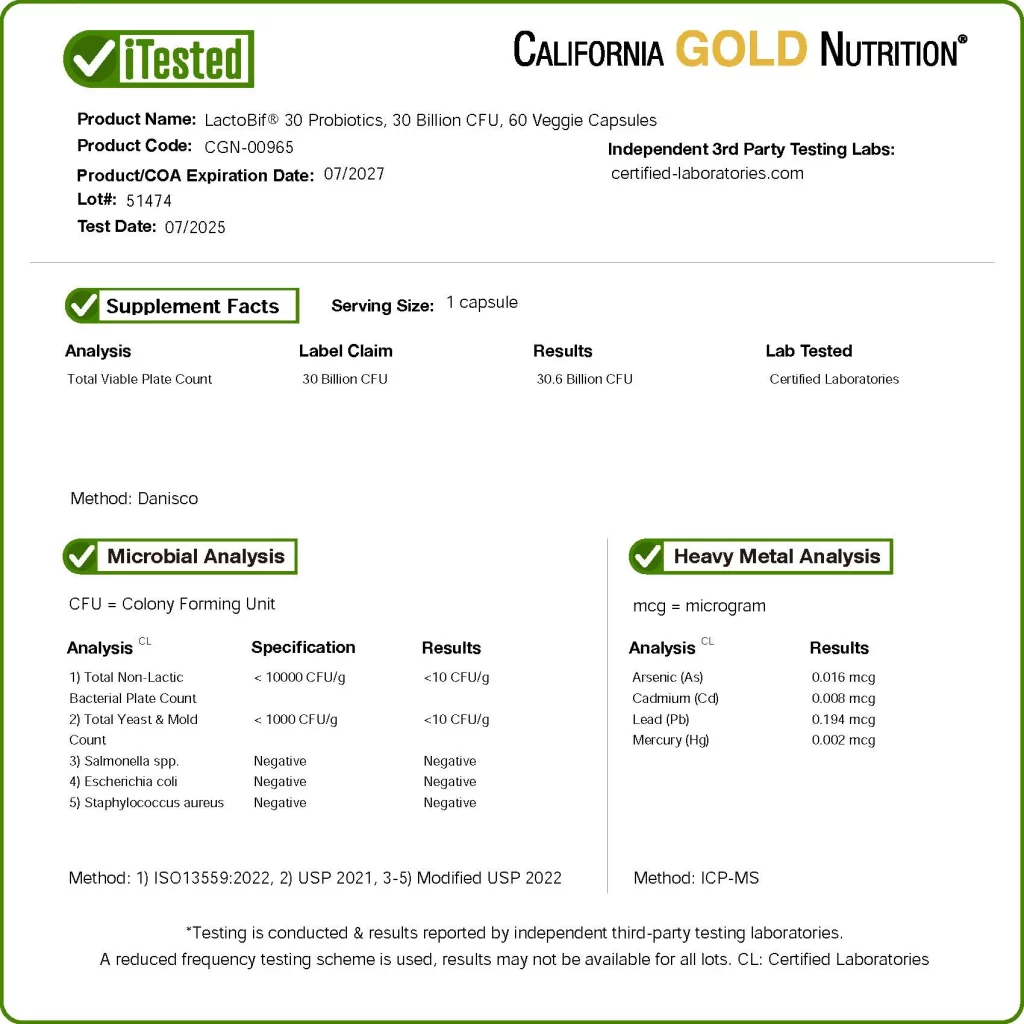
iHerb’s official description: “Through iTested, our independent testing program, select products are routinely tested by accredited, ISO-certified third-party laboratories for potential contaminants. These tests may include, but are not limited to, evaluation of dietary ingredient identity, potency, purity, and key safety parameters, as applicable. When you see the iTested logo, it signifies that the product has undergone additional independent quality verification as part of this program.”
What makes iTested different from standard COA testing
- Testing performed by INDEPENDENT laboratories, not the brand’s own labs
- Labs are ISO-certified (international quality standard for laboratory operations)
- Routine testing schedule, not one-time submission
- iHerb (not the brand) commissions and pays for testing
- Eliminates conflict of interest in test results
- Tests cover identity, potency, purity, contaminants simultaneously
How to find iTested products on ph.iherb.com
Look for the iTested logo on product pages and bottle labels. iHerb’s house brand California Gold Nutrition (CGN) prominently features the iTested logo across most of their product line – this is part of why CGN is recommended as a budget-friendly trustworthy starter brand. Several other brands also participate in iTested for select products. Filter your search results by iTested certification when available.
When choosing between two similar supplements at similar prices, the iTested product is the safer choice. It’s the closest equivalent to having an independent regulatory body verify the product – except faster, more thorough, and ongoing rather than one-time.
Program 4: Preserved Freshness (Climate-Controlled Fulfillment)
Supplements are sensitive to heat, humidity, and light. Improper storage during distribution can degrade active ingredients, reducing potency and creating safety issues. iHerb addresses this through certified fulfillment infrastructure:
- Climate-controlled warehouses in California, Kentucky, Korea, Germany, and Japan
- GMP-certified fulfillment centers (Good Manufacturing Practices for warehousing)
- ISO-certified facility operations (international quality management standard)
- NSF-certified handling protocols (food safety standard organization)
- Exact expiration dates displayed on every product page before purchase
This last point is particularly important for Filipino buyers: international shipping takes 7-14 days, so you want to receive products with plenty of shelf life remaining. iHerb’s transparency on expiration dates lets you choose products with 12+ months of remaining life rather than receiving items about to expire.
Program 5: Easy Returns and Refunds (Customer Protection)
Despite all quality controls, individual orders occasionally have issues – damaged packaging, wrong items, products that don’t meet expectations. iHerb’s stated policy: “If a product doesn’t meet your expectations, we’ll make it right.” In practice:
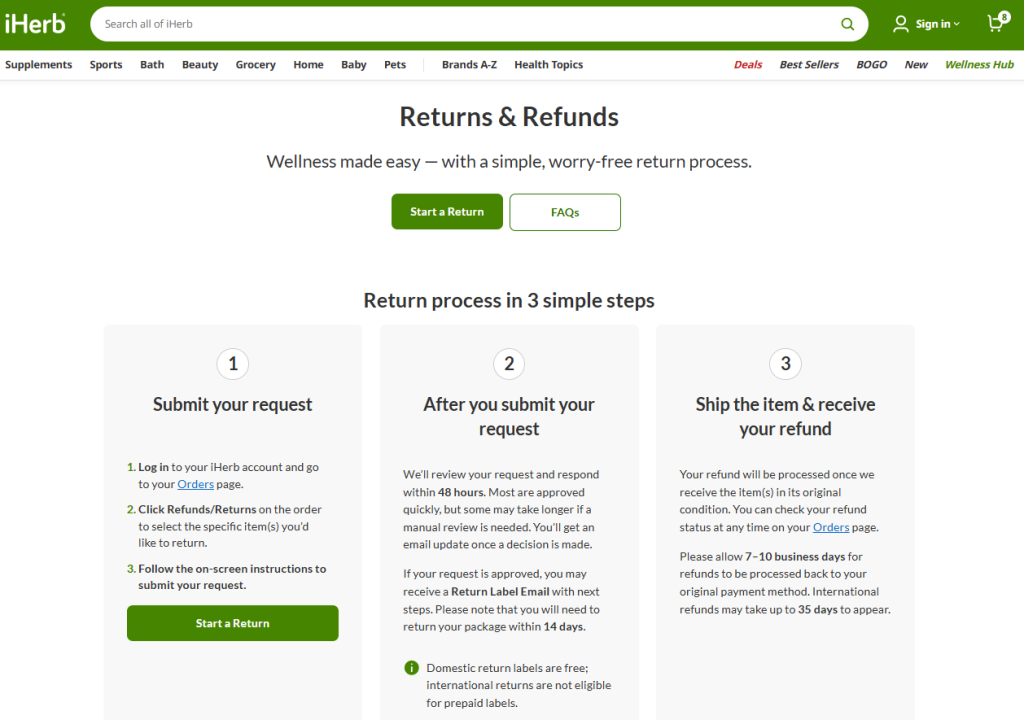
- 60-day return window for unopened items
- Refund or replacement for damaged-in-transit products
- Customer service handles disputes via email or live chat within 24-48 hours
- Documented complaint resolution process backed by BBB A+ rating
- Full return policy at ph.iherb.com/info/returns
iHerb Quality Promise – the four key signals to remember
| Quality Signal | What to Look For on Product Pages |
| Authentic Products | Direct from iHerb (not third-party seller listings) |
| Tested Ingredients | COA available on request – applies to all supplements |
| iTested Logo | Independent ISO-lab verified – HIGHEST quality signal |
| Preserved Freshness | GMP/ISO/NSF facility badges + visible expiration date |
| Easy Returns | 60-day return window noted in terms |
Customer reviews as ongoing quality signal
Beyond formal quality programs, iHerb’s review system provides ongoing quality monitoring through customer feedback at massive scale. iHerb’s official statistics as of 2026:
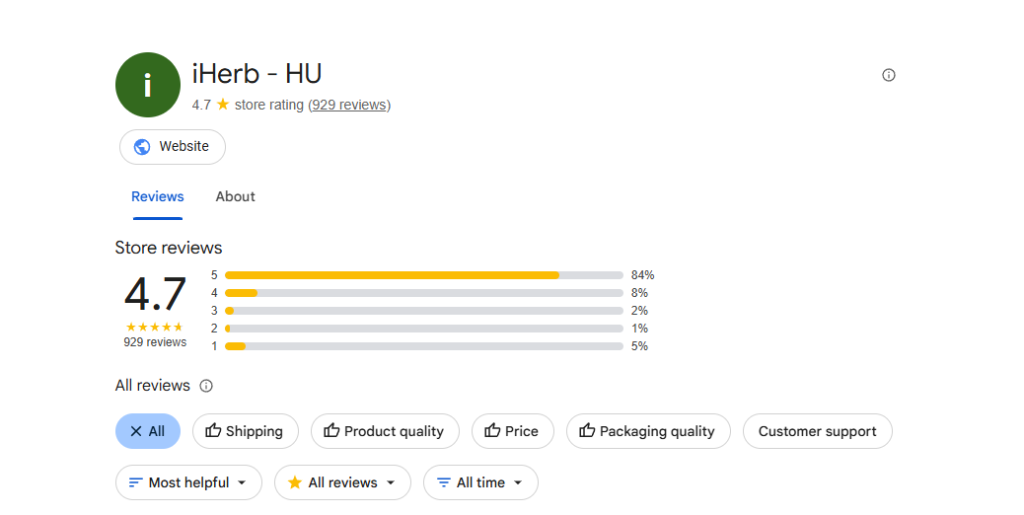
- 4.8/5 stars across 5,800,000+ store reviews on iHerb
- 4.7/5 stars across 60,000+ Google Customer Reviews
- 4.8/5 stars across 164,000+ Apple App Store ratings
- 4.8/5 stars across 700,000+ Google Play ratings
- BBB A+ rating maintained for over a decade
With this volume of customer feedback, quality issues surface within days rather than months. If iHerb consistently sold subpar products, these ratings would have collapsed years ago. Instead, ratings have remained consistently high across multiple independent platforms – the strongest social-proof signal you can ask for from a retailer.
Certifications You SHOULD Look for When Buying Supplements
Instead of searching for ‘FDA approved’ (which doesn’t exist for supplements), here are the actual quality certifications that genuinely indicate well-manufactured, safe supplements. Look for these badges on iHerb product pages or bottle labels:
Quality certification hierarchy
| Certification | What It Means | Reliability |
| iTested (iHerb) | iHerb-commissioned ISO-lab independent testing | Highest – iHerb-specific, comprehensive |
| cGMP / GMP | Manufactured following Current Good Manufacturing Practices | Baseline – required by FDA |
| NSF Certified | NSF International independently verified manufacturing | Strong – facility inspection required |
| NSF Certified for Sport | Tested for banned substances in addition to GMP | Very strong – athletes can trust |
| USP Verified | United States Pharmacopeia verification mark | Strong – voluntary high standard |
| ConsumerLab Approved | Independent lab testing of label accuracy | Strong – tests actual product content |
| Informed Choice | Banned substance testing for sports supplements | Strong – LGC laboratory tested |
| ISO Certified | International quality management standard | Strong – facility-level certification |
| Non-GMO Project | No genetically modified ingredients | Moderate – quality marker for GMO-conscious |
| USDA Organic | USDA certified organic ingredients | Moderate – ingredient sourcing focus |
| Vegan Society | No animal-derived ingredients | Moderate – dietary preference marker |
Reading certification badges on iHerb
When you’re on a product page at ph.iherb.com, certification badges typically appear in three places:
- Product image – badges visible on the bottle label
- Product description – written confirmations of certifications
- Specifications section – structured data showing certifications
Cross-reference any ‘certified’ claim by clicking through to the certifying organization’s verification page. NSF, USP, and ConsumerLab all maintain searchable databases of verified products. A genuine certification holds up under verification; a fake claim doesn’t.
Red Flags That Genuinely Indicate Unsafe Supplements
Now that we’ve debunked the ‘FDA approved’ myth, here are the actual warning signs that a supplement may be unsafe or fraudulent – whether you’re shopping on iHerb or anywhere else:
Product red flags
- Claims to cure or treat specific diseases (illegal under DSHEA, signals shady manufacturer)
- Promises miraculous weight loss, muscle gain, or anti-aging results
- ‘Proprietary blend’ without disclosing individual ingredient amounts
- No third-party testing certification of any kind
- Manufacturer not registered with FDA (check FDA’s Food Facility Registration database)
- Suspiciously low price vs market average (often 30%+ below)
- Sold only through paid social media ads or direct messages, not legitimate retailers
- Packaging appears generic or unprofessional
Source red flags
- Marketplace seller (not direct retailer) on Shopee, Lazada, eBay
- Drop-shippers reselling at marked-up prices without quality control
- Social media sellers with no business registration
- Products from manufacturers with FDA import alerts (check FDA enforcement reports)
- Sellers offering ‘authentic’ products that haven’t been through proper supply chains
Why iHerb passes the red flag test
Evaluated against these criteria, iHerb consistently rates well:
- Direct from manufacturer (not third-party marketplace)
- Strict no-disease-claim policy on product pages
- Most products show third-party certifications
- All manufacturers on iHerb are FDA-registered food facilities
- Prices reflect actual market value (not suspiciously low)
- Professional packaging and warehousing
- 30 million customers and BBB A+ rating provide social proof at scale
This doesn’t mean every product on iHerb is high quality – some brands are better than others, and we’ve reviewed Doctor’s Best, California Gold Nutrition, and others to highlight the best picks. But iHerb as a retailer passes the legitimacy threshold with high confidence.
Trust Verification Checklist for First-Time iHerb Buyers
If you’re still hesitant after reading this, use this checklist before placing your first iHerb order. Go through each item and verify it yourself:
About iHerb (the company)
- Founded 1996 – check Wikipedia or company About page
- Headquartered in California with public address and contact information
- Better Business Bureau A+ rating (check bbb.org)
- Listed in FDA’s Food Facility Registration database
- Operating in 180+ countries with established international shipping
- 30+ million customers verified through review counts
About the specific product you’re considering
- Check manufacturer’s FDA Food Facility Registration
- Look for cGMP certification (baseline)
- Look for at least one third-party certification (NSF, USP, ConsumerLab)
- Read at least 10 verified buyer reviews on the product page
- Check the ‘Supplement Facts’ panel matches what you want to take
- Verify expiration date is at least 6 months out
- Cross-check ingredient claims against Examine.com research
Your first order strategy
- Order 1-2 products to test (don’t bulk order on first attempt)
- Choose well-reviewed bestsellers from established brands
- Stay under USD 170 to avoid customs duties
- Pay with credit card for chargeback protection
- Use welcome code [YOUR-AFFILIATE-CODE] for first-order discount
- Document the experience to inform future orders
Frequently Asked Questions
Are iHerb supplements safe to take?
iHerb supplements sourced from cGMP-certified manufacturers with third-party testing are generally safe when taken at recommended doses. However, ‘safe’ depends on individual health conditions, medications you’re taking, and the specific supplement. Pregnant women, those on prescription medications, and people with chronic conditions should consult their doctor before starting any supplement, regardless of where it’s purchased. iHerb does not provide individualized medical advice.
Are iHerb supplements FDA approved Philippines?
No, because FDA Philippines does not ‘approve’ supplements either – the Philippine regulatory framework follows a similar registration model rather than pre-approval. iHerb does not register individual products with FDA Philippines because they’re not a Philippine commercial distributor. Personal-use imports are typically exempt from FDA Philippines registration requirements under existing customs and import regulations.
Can I get arrested for buying iHerb supplements?
No. Personal-use importation of supplements for your own consumption is legal in the Philippines under standard import rules. The de minimis threshold (USD 170) and personal use exemptions cover typical iHerb orders. You could face issues if you tried to commercially resell iHerb products without FDA Philippines registration, but that’s reselling, not buying. Millions of Filipinos have legally purchased from iHerb without legal issues.
What if customs seizes my iHerb order?
Customs seizures of iHerb orders are rare but possible, typically for orders exceeding the de minimis threshold or containing restricted substances (certain prescription-strength supplements, some Korean weight-loss products). If your order is held, iHerb’s customer service can help with documentation. In most cases, paying applicable duties resolves the issue. See our Customs and Duty Guide for prevention strategies.
How do I know if an iHerb product is genuine?
Buying directly from ph.iherb.com (not Shopee/Lazada resellers claiming to sell iHerb) guarantees authenticity. iHerb’s direct-from-manufacturer sourcing eliminates counterfeit risk in their supply chain. Each product arrives with intact tamper-evident packaging, lot numbers, expiration dates, and manufacturer information. If anything looks suspicious upon arrival (broken seals, missing labels, expired dates), contact iHerb customer service immediately for replacement or refund.
What is the iTested logo and why does it matter?
iTested is iHerb’s proprietary independent third-party testing program. When you see the iTested logo on a product page or bottle, it means iHerb has commissioned an accredited, ISO-certified laboratory to test that specific product for ingredient identity, potency, purity, and contaminants. Unlike standard Certificates of Analysis (which brands self-provide), iTested results come from a lab paid by iHerb directly – eliminating manufacturer conflicts of interest. iHerb’s house brand California Gold Nutrition features the iTested logo on most products. When choosing between similar supplements at similar prices, iTested is the safer choice. Learn more at ph.iherb.com/info/quality.
What does Certificate of Analysis (COA) mean for iHerb products?
A Certificate of Analysis is a laboratory document showing what’s in the bottle matches what’s on the label. iHerb requires all supplement and sports nutrition brands to provide COAs covering ingredient identity, label alignment, contaminants (heavy metals, allergens), and potency. This is the baseline level of quality assurance for ALL iHerb supplements. While COAs are brand-provided (not iHerb-commissioned like iTested), they still represent meaningful documentation that the product contains what’s advertised. You can typically request COAs from iHerb customer service for any specific product.
Is iHerb safer than buying supplements at Watsons or Mercury Drug?
Both are safe when buying authentic products. Local Philippine pharmacies stock products that have completed FDA Philippines registration, providing one additional layer of regulatory review. iHerb provides access to a wider international brand selection that may not have completed Philippine registration but have completed US FDA cGMP requirements and iHerb’s iTested program. Neither is categorically ‘safer’ – both are legitimate sources. The choice depends on price (iHerb wins), selection (iHerb wins), urgency (Watsons/Mercury win), and personal preference for in-person shopping experience.
What’s the difference between FDA registered and FDA approved?
FDA registered means the manufacturer or facility has filed required paperwork with the FDA to do business in the US. This is administrative compliance, not safety verification. FDA approved means the FDA has reviewed and authorized a specific drug product for sale. Almost all legitimate supplement manufacturers are FDA registered. No supplement is FDA approved. Beware sellers claiming ‘FDA registered’ as if it equals ‘FDA approved’ – they’re not the same.
Should I avoid all supplements then?
Not necessarily. The lack of FDA pre-approval doesn’t mean supplements are unsafe – it means you need to be a more careful consumer. Choose well-established brands with third-party testing certifications (iTested, NSF, USP, ConsumerLab), cGMP-certified manufacturing, and verified buyer reviews. Avoid supplements with miracle disease-cure claims, proprietary blends hiding ingredient amounts, and suspiciously low prices. iHerb makes this easier by curating products from established manufacturers and displaying third-party certifications clearly via their iTested program at ph.iherb.com/info/quality.
Final Verdict: Is iHerb Safe for Filipino Buyers?
After examining how dietary supplement regulation actually works in the United States and the Philippines, the honest answer is clear: the ‘is iHerb FDA approved’ question is based on a misconception. No supplement retailer is or can be ‘FDA approved’ in the way drugs are. What matters instead is the quality assurance system – and iHerb’s five-pillar Quality Promise (Authentic Products, Tested Ingredients via COA, iTested third-party verification, Preserved Freshness, Easy Returns) is one of the most robust systems in the consumer supplement industry.
iHerb meets every realistic safety standard
- Sources directly from cGMP-certified manufacturers (no third-party sellers)
- Required Certificates of Analysis (COA) for all supplement products
- iTested independent third-party testing program with ISO-certified labs
- GMP/ISO/NSF-certified climate-controlled warehousing in 5 countries
- Strict labeling compliance with FDA requirements
- 5.8M+ store reviews averaging 4.8/5 plus 4.8/5 across app stores
- BBB A+ rating maintained for over a decade
- Direct manufacturer accountability if issues arise
- 60-day return policy for customer protection
Filipino-specific considerations
- Personal use imports are legal under Philippine customs rules
- Stay under USD 170 de minimis threshold to avoid duties
- Order single-person quantities to stay within personal use exemption
- Pay via Philippine credit card or GCash for transaction protection
- Verify product reviews from Filipino buyers when possible
- Prefer iTested-certified products when available, especially California Gold Nutrition
If you’ve been hesitating to order from iHerb because of FDA approval concerns, you can move forward with confidence. The concern was based on misunderstanding what FDA approval means. The real quality signals – cGMP manufacturing, iTested independent verification, third-party testing certifications, established manufacturer reputation, verified customer reviews – are all present on iHerb at scale.
Your responsibility as a careful consumer is to evaluate individual products before purchasing: look for the iTested logo, check certifications, read reviews, verify dose appropriateness for your needs, and consult your doctor if you have specific health conditions. iHerb provides the infrastructure for informed decisions; you make the actual decisions.
Ready to make your first informed iHerb purchase? Browse certified supplements on ph.iherb.com using code BBS5750 for welcome discount. Look for the iTested logo, plus NSF, USP, or ConsumerLab certification badges. Start with 1-2 well-reviewed products under USD 170 to test your delivery experience. Pay via Philippine credit card for chargeback protection. Welcome to informed supplement shopping.


Related Trust and Safety Guides
- Is iHerb Legit? Honest Filipino Review – comprehensive trust evaluation
- iHerb Customs and Duty Guide Philippines – de minimis rules and personal use limits
- iHerb Philippines Physical Store – online-only model explained
- iHerb Philippines Shipping Guide – delivery options and timing
- California Gold Nutrition CollagenUP Review – Is This Marine Collagen Worth Buying for Filipinos?
- How to Pay iHerb with GCash – payment security guide
Authoritative Sources for Further Reading
- iHerb Quality Promise (official): ph.iherb.com/info/quality
- iHerb Return Policy: ph.iherb.com/info/returns
- FDA Dietary Supplements page: fda.gov/food/dietary-supplements
- DSHEA full text: congress.gov (search ‘Dietary Supplement Health Education Act 1994’)
- FDA Philippines official site: fda.gov.ph
- Republic Act 9711 (FDA Act of 2009): officialgazette.gov.ph
- NSF International supplement verification: nsf.org
- USP Verified Mark database: quality-supplements.org
- ConsumerLab independent testing: consumerlab.com
- Examine.com supplement research: examine.com
Editorial Disclosure: This article provides general consumer education about supplement regulation and iHerb’s Quality Promise programs. Information about iHerb’s quality programs sourced directly from ph.iherb.com/info/quality (verified June 2026). This article is not legal advice, medical advice, or a substitute for consultation with qualified professionals. Regulatory frameworks (US FDA, FDA Philippines, customs rules) can change – verify current rules through official government sources before making purchase or import decisions. SupplementPH participates in iHerb’s affiliate program through Involve Asia, meaning we may earn commission on purchases made through links in this article at no cost to you. Commission does not influence editorial assessment. See our Affiliate Disclosure and Medical Disclaimer pages for full transparency.